As the 5G wave sweeps the world, as AI computing power breaks through the boundaries of the cloud, and as the demand for “real-time response” becomes increasingly urgent across industries… a new computing paradigm driven by edge intelligence is quietly emerging, reshaping the ecosystem value logic of countless industries.
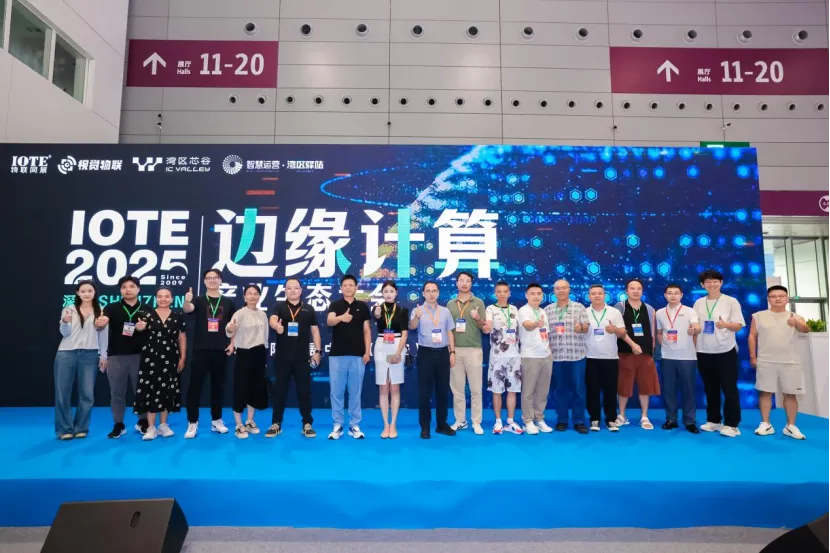
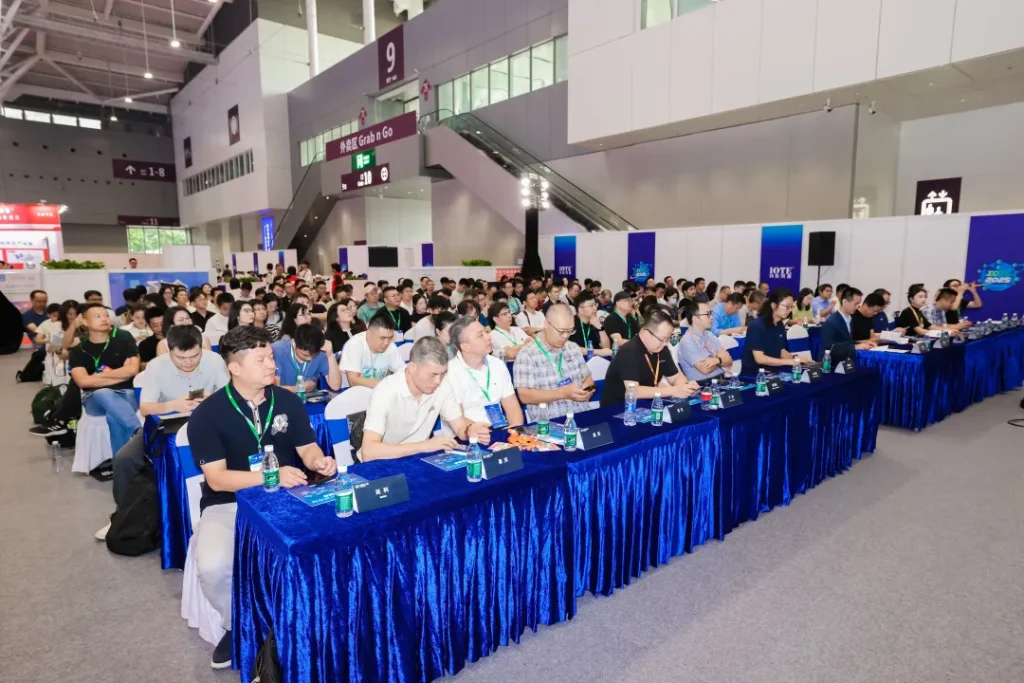
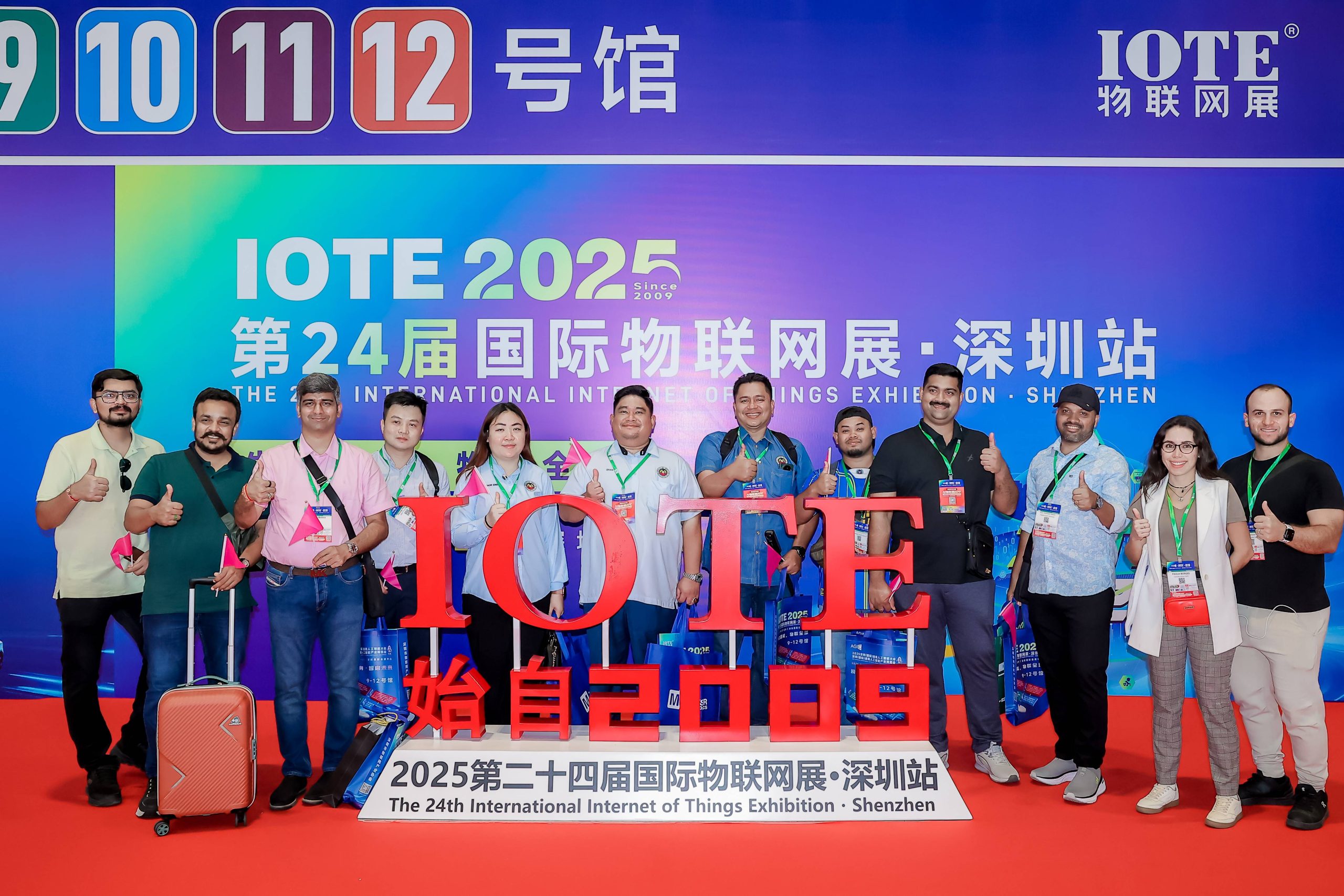
On August 27th, the “IOTE 2025 Shenzhen Edge Computing Industry Ecosystem Conference,” co-organized by Vision IoT, Shenzhen Bay Area Station Innovation Technology Service Co., Ltd., and Shenzhen Smart Park Operation Service Co., Ltd., concluded successfully at Hall 9, Venue 1, of the Shenzhen International Convention and Exhibition Center (Bao’an).

This conference focused on the edge computing ecosystem and featured several key guests from across the industry chain, including Liu Jianwei, Co-founder and Vice President of Aixin Yuanzhi; Zhu Caizhi, CEO of Interlink; Zhang Weichao, Head of Product Marketing at Houmo Intelligent; Liu Dayu, Business Director of Visual AI Applications at Hikvision; Peng Guorui, Senior Architect of the Manufacturing Industry at Baidu Smart Cloud; and Wang Xu, Co-founder of Yingkaihong. They engaged in in-depth discussions and shared insights on key topics such as the technological evolution path of edge computing, industry convergence trends, and commercial application implementation, discussing new opportunities and the future of edge computing.
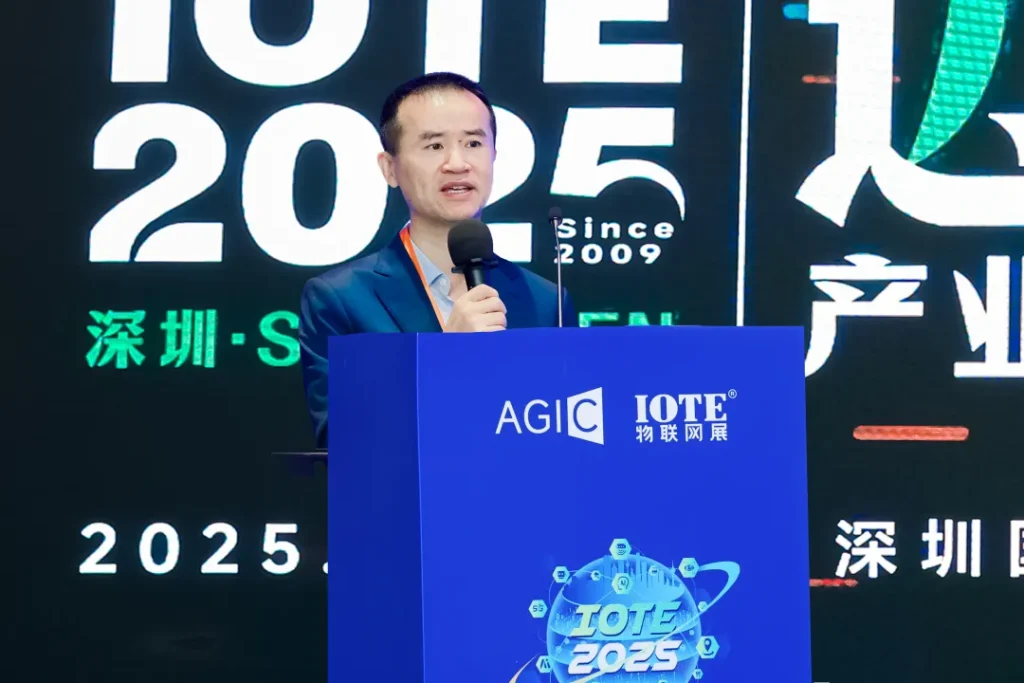
The conference began with a speech by Yang Weiqi, Executive President of the Shenzhen Internet of Things Industry Association. He stated that with exponential advancements in cutting-edge technologies like the Internet of Things and artificial intelligence (AI), we are entering a fully connected, data-driven intelligent era. Faced with the demand for massive, real-time data processing, edge computing has become a key technological enabler and is poised for explosive growth. We hope that through the exchange of ideas and technologies at this event, we can accelerate breakthrough innovations in key core technologies in the field of edge computing, give rise to more benchmark application scenarios across industries and fields, and build an open and collaborative industrial innovation ecosystem.
Subsequently, the “2025 Edge Computing Market Research Report” launch ceremony was officially launched. Led by Yang Weiqi, Executive President of the Shenzhen Internet of Things Industry Association, eight guests attended the event, including Liu Jianwei, Co-founder and Vice President of Aixin Yuanzhi; Zhu Caizhi, CEO of Interlink; Zhang Weichao, Head of Product Marketing at Houmo; Liu Dayu, Business Director of Visual AI Applications at Hikvision; Peng Guorui, Senior Architect of the Manufacturing Industry at Baidu Intelligent Cloud; Wang Xu, Co-founder of Yingkaihong; Xi Andi, Chief Researcher at Shenzhen Bay Area Station Innovation Technology Service Co., Ltd.; and Yan Ke, Head of Visual IoT. This marked the official release of the “2025 Edge Computing Market Research Report.”
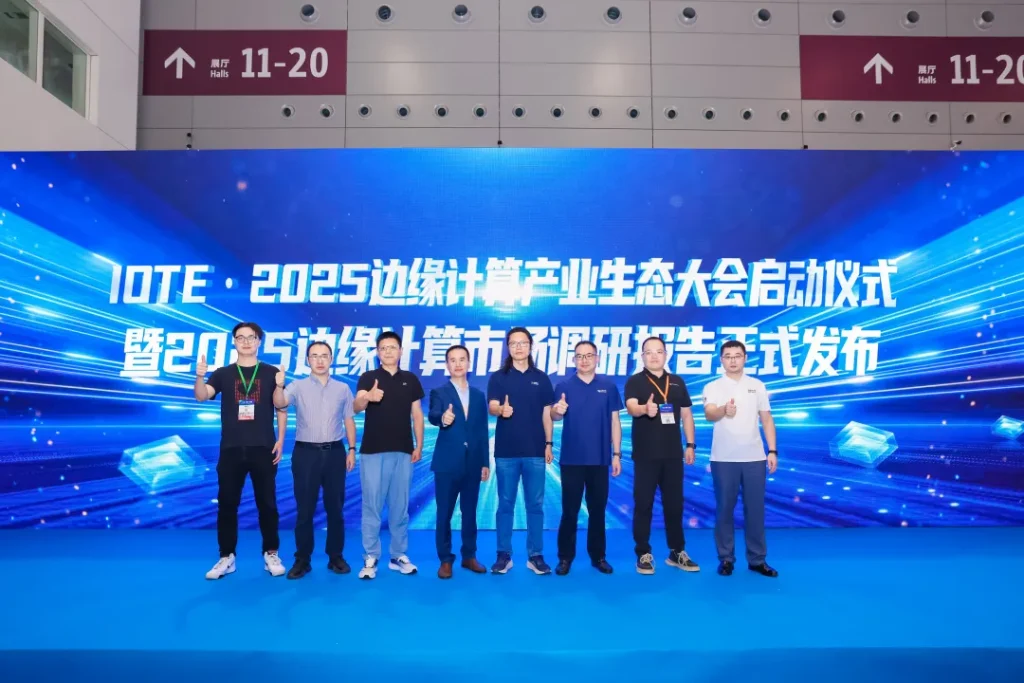
After the report release session, the conference officially entered the core discussion session. Several speakers took the stage, outlining a complete technical roadmap for edge intelligence, from proof-of-concept to large-scale commercialization, covering technological breakthroughs in edge computing to industry implementation.
AI Native Processors: Unleashing Intelligent Productivity
In recent years, with the deepening advancement of intelligentization across numerous industries, artificial intelligence is moving from technical exploration to large-scale application, becoming the “intelligent infrastructure” supporting social and economic development. At the conference, Liu Jianwei, Co-founder and Vice President of iCore, delivered a keynote speech titled “AI Native Processors: Unleashing Intelligent Productivity.” He pointed out that the continuous evolution of intelligent computing has not only driven the rapid development of AI processors, but also placed higher demands on chip performance, including key indicators such as high parallel computing power, low power consumption, and high energy efficiency, driving a productivity revolution centered on cost-effectiveness.
As a leading company specializing in the research and development of artificial intelligence perception and edge computing chips, Aixin Yuanzhi adopts the dual-core architecture concept of “operator instruction set + data flow DSA microarchitecture” in the design of AI processors, achieving a several-fold improvement in FPS/W energy efficiency, and providing an economical and feasible solution for the efficient deployment of complex AI models on the edge. Taking its AX8850 product as an example, it demonstrates strong multi-scenario adaptability and technological leadership. The chip supports multi-modal interactions such as text-to-image search, image-to-text search, image-to-text generation, and video understanding. It can smoothly run mainstream large models such as MiniCPM-V, StableDiffusion, DeepSeek, and Qwen2.5-VL, and can realize multi-modal capabilities such as BEV Demo and 4D Radar-Camera Fusion, showing a wide range of application potential.

The Future of IoT:
The Big Model-Driven Revolution in Edge Intelligence Collaboration
The global IoT industry is experiencing a period of massive growth, and edge intelligence has become a core hub for unlocking IoT value. At the same time, big model technology, with its powerful data processing and decision-making optimization capabilities, is revolutionizing edge intelligence. At the conference, Interlink CEO Zhu Caizhi delivered a keynote speech titled “The Future of IoT: The Big Model-Driven Revolution in Edge Intelligence Collaboration.” Addressing the industry pain points of traditional edge AI, such as limited computing power, significant accuracy bottlenecks, and high model production costs, big models are rapidly evolving toward multimodal fusion and cloud-edge-device collaboration, providing key technical support for overcoming these bottlenecks in edge intelligence.

As a pioneer in AI implementation focused on vision, Interlink has built a comprehensive AI model ecosystem encompassing “big models for vision foundation, multimodal models, industry-specific big models, and small models,” using big models to drive enhanced efficiency in edge intelligence collaboration. For example, its Lingxi multimodal big model, available in two hardware form factors, can fine-tune the 7B big model, enabling edge-device integration. This reduces the frequency of big model calls and, consequently, reduces costs. The intelligent computing hub product, through its innovative architecture of “fast detection using a small front-end model combined with secondary confirmation using a large, industry-specific model,” enables nearly 1,000 camera alarms, achieving a false alarm filtering rate of up to 96.5%, while maintaining a high cost-effectiveness and high performance. Looking ahead, IntelliTa will continue to leverage technological innovation to advance vision systems as the eyes of the new AGI world, injecting strong momentum into the implementation of AI in the IoT.
The Computing Revolution in the Era of Big Models
– “Storage-and-Compute Integration” Reshapes the Intelligent Experience at the Edge
Currently, Gen AI is on the verge of a breakout, with big models accelerating towards the “three transformations” of commercialization, specialization, and lightweighting. As big models continue to migrate to devices and the edge, hybrid AI is becoming a key development trend. It’s predicted that 90% of data processing will occur at the edge in the future, bringing new opportunities to the industry. At this conference, Zhang Weichao, Head of Product Marketing at Houmo Intelligent, delivered a speech titled “The Computing Revolution in the Era of Big Models – ‘Storage-and-Compute Integration’ Reshaping the Intelligent Experience at the Edge.”
Houmo Intelligent has launched its self-developed Houmo Manjie® M50 chip with an innovative storage-computing integrated architecture, greatly enhancing computing efficiency and bandwidth utilization for large edge AI models. Based on the M50, the company offers a full product lineup including the LQ50 series M.2 cards, LM5050/LM5070 accelerator cards, and the BX50 intelligent computing box. The M50 features ultra-low power consumption, compact design, multi-core interconnect, and local computing for enhanced data privacy and reduced latency. The LQ50 M.2 card supports on-device inference of models with tens of billions of parameters, while the dual-chip LQ50 Duo overcomes 14B/32B model deployment limits. The LM5050/LM5070 accelerator cards deliver up to 640 TOPS of scalable performance and multi-card interconnection. Houmo Intelligent continues to build a “low-power, high-security, superior-experience” edge AI ecosystem, enabling large models to move beyond the cloud and empower intelligent edge devices.

Intelligence at the Edge:
The Industry-Enabling Practice of Perception Big Models
With the continued development of the AIoT industry and the explosive growth in big model applications, the convergence of AIoT and big model technologies is accelerating. This convergence not only supports the implementation of big models across various industries and application scenarios, but also significantly drives the industry’s digital transformation. At the conference, Liu Dayu, Director of Visual AI Application Business at Hikvision, delivered a fascinating presentation titled “Intelligence at the Edge: The Industry-Enabling Practice of Perception Big Models.”
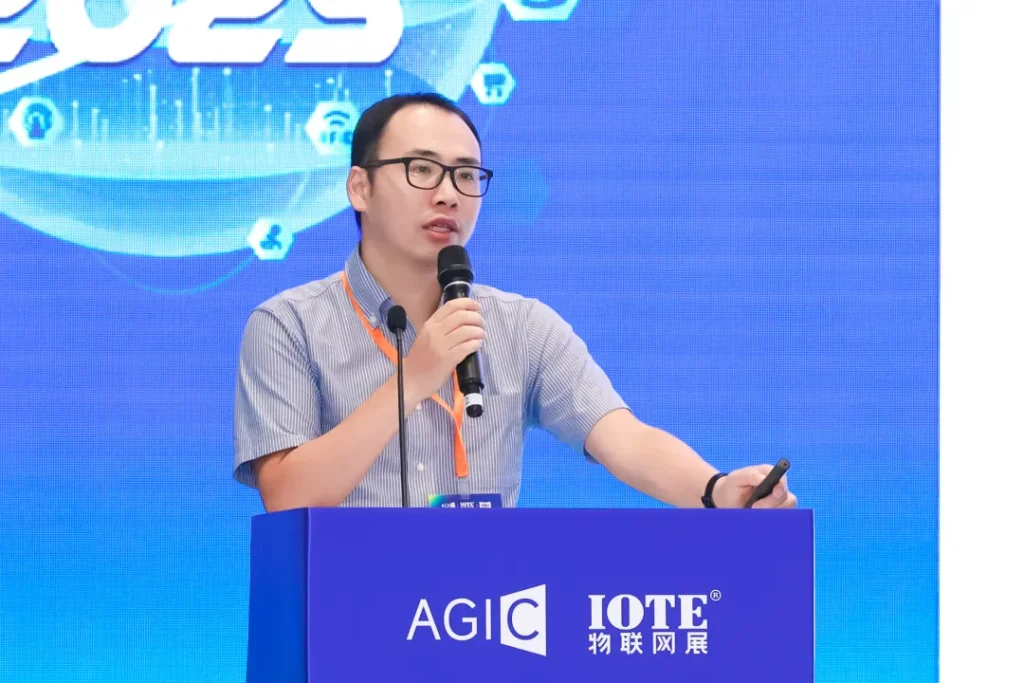
In 2024, Hikvision officially achieved large-scale implementation of the Hikvision Guanlan big model. According to Liu Dayu, Hikvision currently leverages IoT perception and AI big model technologies as a foundation to fully empower digital services in the security sector and various other scenarios. This technology has enabled breakthroughs such as increased perception accuracy, complex event reasoning, and innovative human-computer interaction. Going forward, Hikvision will continue to deepen its AI and IoT deployment with a three-step strategy: digging wells, spreading networks, and building an ecosystem.
Empowering Multimodal Vision Reconstruction at the Edge
Enabling Professional-Grade Visual AI Applications at the Edge
In recent years, the AIoT has flourished, and its implementation continues to advance at a steady and rapid pace. This prosperity is inseparable from the continuous iteration and upgrade of cutting-edge technologies such as AI and big models, as well as the strong support of an open source ecosystem. At the conference, Peng Guorui, Senior Architect for the Manufacturing Industry at Baidu Smart Cloud, delivered a fascinating presentation titled “Empowering Multimodal Vision Reconstruction at the Edge, Enabling Professional-Grade Visual AI Applications at the Edge.” Leveraging a solid foundation of revenue exceeding 100 billion yuan for seven consecutive years, R&D investment exceeding 180 billion yuan over ten years, and patent advantages, Baidu Smart Cloud has established a full-stack AI stack in the field of artificial intelligence, from chips (Kunlun Core) to frameworks (Plasma), models (such as Wenxin Yiyan), and finally the application layer. These layers work together to provide a solid foundation for multimodal vision reconstruction at the edge.
Large visual models are evolving from discriminative to generative multimodal paradigms. In the large-model era, vision-driven digital management is booming, with large-and-small model collaboration emerging to solve traditional small-model pain points: long cycles, high costs, and weak generalization. This enables end-to-end intelligence from real-time perception to complex reasoning, significantly boosting edge cost-effectiveness.
Baidu Smart Cloud has launched multiple hardware platforms, including the Dumu Video AI All-in-One and DeepSeek P800 Dual-Engine Large Model All-in-One, covering edge-to-center deployment and delivering strong results in safe production and service compliance scenarios.
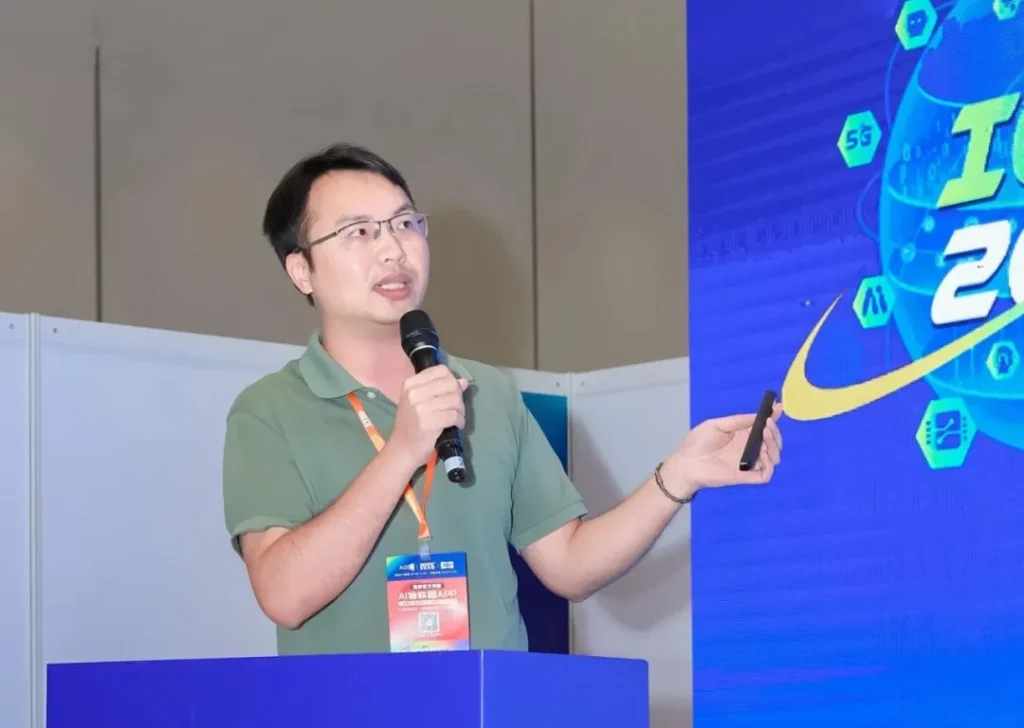
Open-source HarmonyOS Empowers Edge Computing and Explores New Forms of Smart Hardware
In recent years, with the integration of more devices and scenarios, HarmonyOS has gradually developed into a vast and comprehensive ecosystem, providing users with a richer and more convenient smart living experience. At this conference, Wang Xu, co-founder of Hard Open HarmonyOS, delivered a keynote speech titled “Open-source HarmonyOS Empowers Edge Computing and Explores New Forms of Smart Hardware.” Since its launch, the open-source HarmonyOS has continuously evolved around the core goal of “building an intelligent operating system for the era of the Internet of Everything,” gradually developing three core features: scalability, ease of development, and cross-device compatibility.
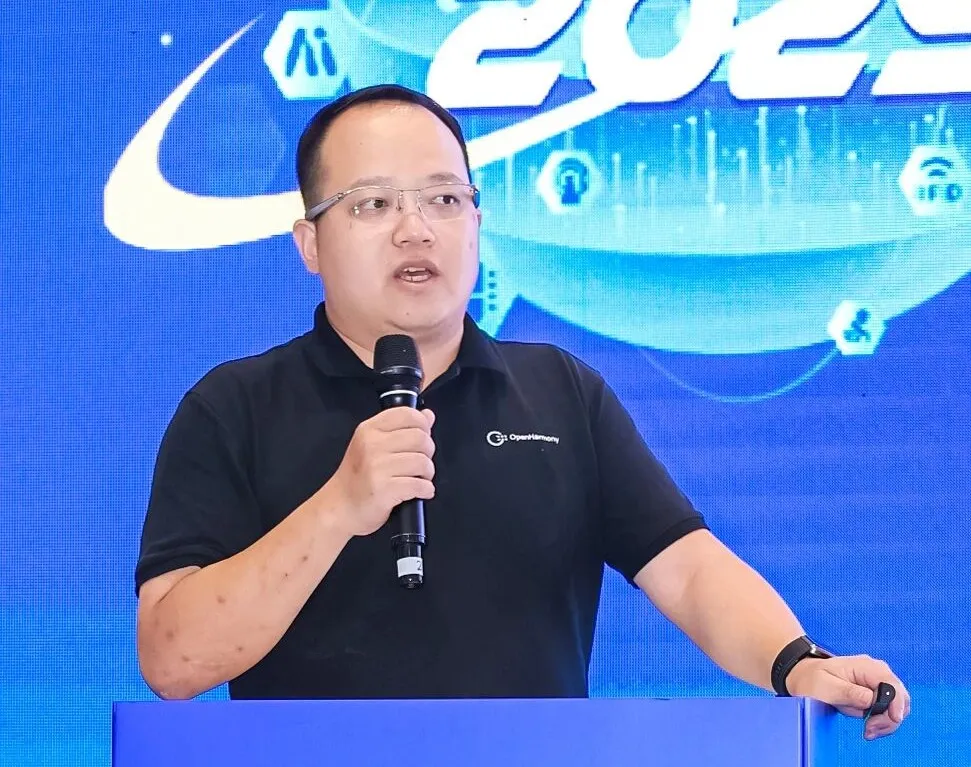
Wang Xu stated that the technical value of open-source HarmonyOS lies not in simply imitating existing operating systems, but rather in independent innovation for distributed applications across all scenarios. It has the potential to support billions of connected devices and provide solid terminal system support for thousands of industries. In his speech, Wang Xu highlighted how open-source HarmonyOS empowers edge computing scenarios such as urban lifelines, transportation, smart homes, and home security. He specifically mentioned that the deep integration of open-source HarmonyOS and Star Flash has further enhanced the collaborative capabilities of edge devices. As an important builder of the open source HarmonyOS ecosystem, HardOpenHong has the vision of “making open source HarmonyOS easy to make hardware” and provides customers with technical services covering system adaptation, hardware solutions, application customization, etc., and has built full-chain capabilities from supply chain to solutions.
The conclusion of the “IOTE 2025 Shenzhen Edge Computing Industry Ecosystem Conference” is not the end, but the beginning of a new journey. This conference not only showcased the achievements of edge computing technology but also served as an important bridge for collaboration within the industry ecosystem. “The value of edge computing lies in its implementation, and the key to implementation lies in its ecosystem.” In the future, edge computing will continue to evolve in areas such as the deployment of large AI models, computing-network integration, and green computing, empowering intelligent upgrades across numerous industries.